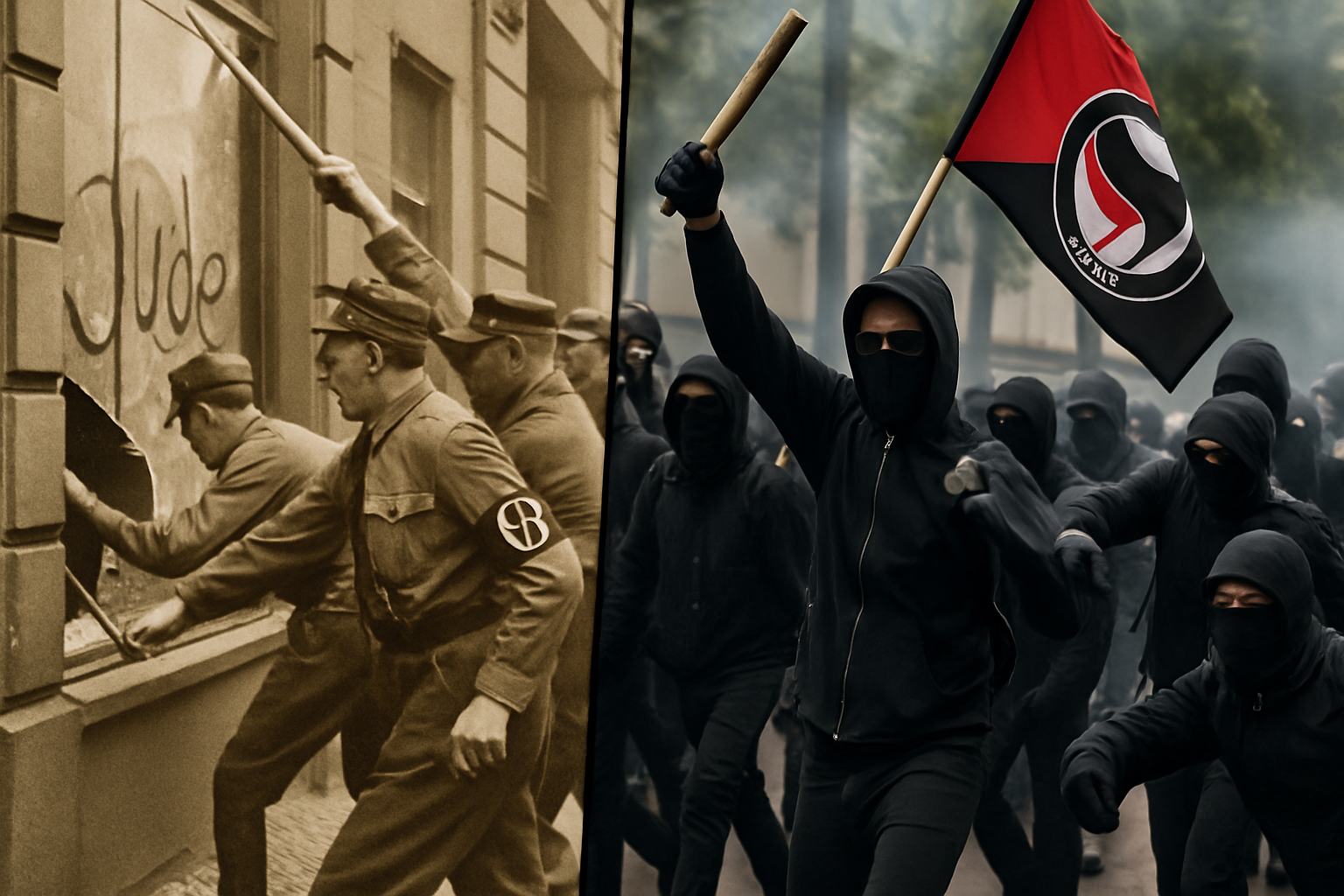
The twentieth century taught us a brutal lesson: totalitarian movements do not politely wait their turn at the ballot box. They seize power by manufacturing chaos, undermining civil order, and convincing the public that only their iron hand can restore stability. Germany’s Nazi Party perfected this method in the 1920s and 1930s. Today, we see the same tactics repackaged in the streets of America by Antifa and their fellow travelers. The uniforms have changed, but the method is identical.
In Weimar Germany, Adolf Hitler’s Sturmabteilung — the SA, better known as the Brownshirts — were unleashed not as a debating society, but as a street army. They prowled cities in organized gangs, disrupting political rallies, smashing storefronts, intimidating voters, and brawling with Communists and Social Democrats. It was a strategy of disruption and fear. By making democratic politics impossible, they could declare democracy itself a failure. Their goal was not persuasion, but domination.
Fast forward a century, and America’s cities have witnessed the rise of Antifa, a movement that insists it is nothing more than an “idea” but behaves like a coordinated militia. The black bloc, with its masks and uniform anonymity, is a direct echo of the Brownshirt aesthetic. Like their German predecessors, Antifa specializes in violence against opponents — not through reasoned debate, but by silencing speakers, smashing property, and turning city centers into battlegrounds.
The parallels are too stark to ignore.
Nazis stormed beer halls to silence dissent. Antifa storms lectures and public events to drive out voices they brand “fascist.” Nazis intimidated shopkeepers and vandalized businesses tied to their enemies. Antifa smashes windows, torches police cars, and paints neighborhoods with the threat of more to come. Nazis framed their violence as “self-defense” against an allegedly greater threat — the “red menace.” Antifa cloaks its attacks in the same excuse, insisting they are preemptively defending society against fascism, even when their victims are ordinary citizens, journalists, or small business owners.
Both movements thrive on instability. Both grow in the cracks of weak political leadership unwilling to enforce law and order. And both sell their brutality as moral necessity.
The danger is not simply the destruction of a few buildings or the disruption of a few meetings. It is the normalization of mob power. When mobs dictate who may speak, who may gather, and who may own property without fear of reprisal, then the principle of equal justice under law is dead. Germany learned this lesson too late. The violence of the SA opened the path for Hitler’s dictatorship, and the German people traded liberty for the false promise of order.
We must not make the same mistake. America cannot afford to wink at organized political violence, no matter what slogans its foot soldiers chant. If we tolerate chaos from one faction because we dislike its enemies, we are sawing off the very branch of liberty we all sit on.
The lesson of the 1930s is clear: stop the mobs early, before they stop you.