Norway is routinely presented to Americans as proof that a generous social democracy can provide nearly everything a citizen needs without imposing any serious hardship. Government-supported healthcare. Subsidized education. Paid parental leave. Extensive public transportation. A broad social safety net. High reported standards of living.
The sales pitch is simple: Norway has found a kinder and more enlightened way to organize society, and America merely lacks the political courage to follow it.
What the sales pitch leaves out is the bill.
Norway does not provide these benefits for free. No government does. It pays for them through taxes on work, taxes on consumption, taxes embedded in prices, restrictions on competition and the enormous petroleum wealth accumulated in its sovereign wealth fund. Norwegian citizens receive substantial public benefits, but they also live inside one of the world’s most expensive consumer economies.
The honest question is not whether Norwegians receive something in return. They unquestionably do. The question is what they surrender—and what Americans would have to surrender—to finance the same system.
Smaller Homes at Higher Prices
Begin with the most visible measure of material life: the family home.
A reasonable estimate places the typical residence occupied by a Norwegian family of four at approximately 1,500 to 1,700 square feet. The comparable American family generally occupies something closer to 2,000 to 2,300 square feet.
In practical terms, the American family may enjoy roughly 600 additional square feet of living space—35 to 40 percent more room.
That does not mean every American lives in a suburban palace or every Norwegian lives in a cramped apartment. It means that the ordinary American standard of residential space remains substantially more generous.
Norway’s smaller homes reflect geography, construction costs, population patterns and regulation as well as taxation. But that is precisely the point. Political systems operate in the real world, not in ideological pamphlets. When labor, land, materials, energy and regulatory compliance cost more, families receive less house for their money.
Norway may offer a stronger public safety net, but the Norwegian family frequently purchases that security while living in a smaller private space.
Fewer Cars—and Less Freedom From the Schedule
A Norwegian family of four typically has access to approximately 1.4 to 1.6 automobiles. The comparable American household has roughly 2.2 to 2.4 vehicles.
Norway’s defenders can reasonably point to its superior public-transportation system. Oslo offers metro trains, trams, buses, commuter rail and ferries. Other Norwegian cities maintain useful transit networks, and the country coordinates many services through a national travel-planning system.
That is a genuine advantage.
But public transportation and private transportation do not provide identical forms of liberty. A train moves where the line was built. A bus travels when the schedule permits. A private automobile leaves when its owner chooses, carries children and groceries directly home and travels to the places that planners did not find economical to serve.
Norwegians living outside major urban centers often need cars just as Americans do. Rural transit can be infrequent, and Norway’s mountainous terrain, long coastline and widely dispersed northern settlements make universal service impossible.
The social-democratic model does not abolish transportation costs. It shifts a portion of those costs from the individual fare or automobile payment into taxation and public subsidy. Norway spent heavily to create a system in which a second car is less necessary. That may be a reasonable bargain, but it remains a bargain—not a gift.
The Grocery Bill Tells the Story
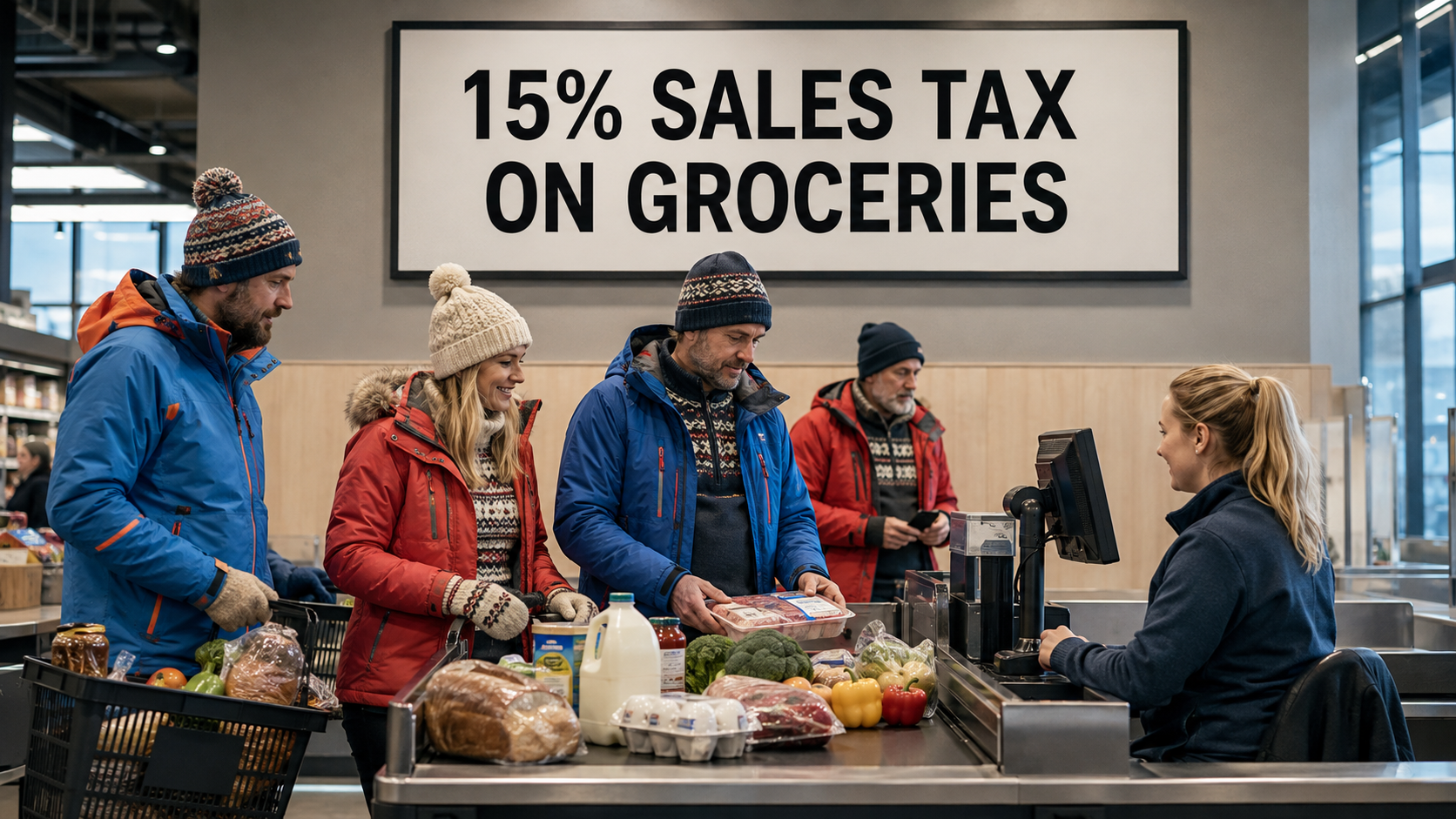
Norwegian grocery prices are generally about 25 to 35 percent higher than comparable American prices. Meat, dairy products, fresh produce, soft drinks, convenience foods and imported brands can cost considerably more.
Eurostat placed Norwegian food and nonalcoholic-beverage prices at approximately 133 percent of the European Union average in 2025. Norway ranked among the most expensive food markets in Europe.
A representative Norwegian family of four can require roughly $1,350 to $1,550 per month for a balanced, moderate grocery budget. A comparable American budget generally falls around $1,250 to $1,450, while the USDA’s tightly constrained Thrifty Food Plan comes in near $1,000.
Norway’s geography explains part of this. Its growing season is short, its labor costs are high and many foods must travel considerable distances.
Government policy explains another part. Norway protects domestic agriculture with tariffs and import restrictions. It also imposes a 15 percent value-added tax on food. In much of the United States, groceries are exempt from state sales taxes.
The Norwegian government helps support the citizen—and then collects revenue when that citizen buys dinner.
An Oil Nation With Nine-Dollar Gasoline
The most striking comparison may be found at the gasoline pump.
In August 2026, ordinary Norwegian gasoline cost approximately $2.35 per liter, equivalent to about $8.90 per American gallon. The U.S. national average stood near $4.05 per gallon.
Norwegian gasoline therefore cost more than twice as much.
A 15-gallon-equivalent fill-up would cost approximately $61 in the United States and $134 in Norway.
Norway is not suffering from a lack of petroleum. It is one of the world’s important oil and gas producers. Its high pump prices are partly a political choice. The government imposes substantial taxes and environmental charges to discourage fossil-fuel consumption and push drivers toward electric vehicles and public transportation.
Again, Norwegians receive something in exchange. Their roads, transit subsidies and public programs do not materialize from the mist rolling across the fjords. But the motorist pays the price immediately, visibly and repeatedly.
Social democracy does not make energy inexpensive. It uses expensive energy as a tool for directing human behavior.
Taxed When You Earn—and Again When You Spend
Norway’s standard value-added tax is 25 percent. Food carries a reduced—but hardly insignificant—15 percent rate. Passenger transportation, hotel rooms and certain cultural services are generally taxed at 12 percent.
This taxation is built into the displayed price. It follows the citizen through ordinary life: clothing, household goods, repairs, services and nearly every consumer purchase.
Labor carries its own burden. The OECD calculated that the tax wedge for an average single Norwegian worker was 36.4 percent of total labor costs in 2024. The “tax wedge” includes income taxes and compulsory employer and employee contributions, measuring the distance between what labor costs an employer and what the worker ultimately receives.
Americans certainly pay taxes, and the American system hides many of them just as effectively. But Norway’s model depends upon broad taxation that reaches deeply into the middle class. It cannot be financed solely by taxing billionaires, oil companies or some imaginary handful of villains at the top.
The middle class is where the money is.
That is the part American advocates of Scandinavian government rarely emphasize. A universal welfare state requires universal participation in financing it. If everyone receives benefits, nearly everyone must help pay.
Norway’s Exceptional Advantage
There is another fact that cannot honestly be ignored: Norway is not merely a social democracy. It is a small, wealthy, energy-exporting nation with an extraordinary sovereign wealth fund built from petroleum revenue.
That fund has accumulated well over a trillion dollars for a population of fewer than six million people. It gives Norway a financial cushion that most countries—including the United States on a per-citizen basis—do not possess.
Oil wealth does not explain every Norwegian success. The country is stable, productive, well-governed and socially cohesive. Those qualities matter. But it is intellectually dishonest to point to Norwegian spending while pretending its petroleum fortune is incidental.
America has more than 340 million people, vast regional disparities, expensive global defense commitments and a political system built around divided sovereignty. Importing Norway’s promises without importing Norway’s population, oil fund, institutions and social conditions would not reproduce Norway.
It would reproduce the spending.
Security Has a Price
Norway is not a failed country. It is not a socialist prison. It remains a prosperous market economy with private property, private businesses and substantial individual freedom. Any serious criticism should begin by admitting those facts.
But its social democracy does not repeal scarcity.
Norwegians often receive more government-supported services, but they also accept smaller homes, fewer private vehicles, higher grocery prices, punishing gasoline costs and taxes embedded throughout daily life. They exchange a portion of private purchasing power for collective provision and state-managed security.
Some people may consider that exchange worthwhile. Others may not.
What Americans must reject is the childish claim that no exchange exists.
Every public benefit consumes resources that citizens could otherwise direct themselves. Every subsidy must be financed. Every “free” service has a worker, building, vehicle, medicine or machine behind it. Government can conceal the payment, redistribute it or delay it. Government cannot erase it.
Norway’s social democracy offers security, but security is not freedom, and it is never free.
The bill always comes due.

