Every civilization answers one question before it answers any others: who rules whom.
Not rhetorically. Not ceremonially. In practice. When law is enforced, taxes are collected, soldiers are sent, and dissent is punished, authority reveals its true shape.
Christianity answered that question with a sentence so short and deceptively mild that many readers miss the explosion hidden inside it: render unto Caesar what is Caesar’s, and unto God what is God’s.
That was not a call to obedience. It was a declaration of jurisdiction.
For the first time in recorded history, political authority was stripped of sacred status without being stripped of legitimacy. Caesar could tax you, draft you, imprison you. But Caesar could not own your conscience. The state was real. God was higher. And the two were not the same thing.
That single fracture is the cornerstone of the Western political inheritance.
Islam answers the same question in the opposite direction. Law, worship, morality, and governance are meant to flow from one source and terminate in one system. The state does not merely coexist with religion; it enforces it. Political authority is not desacralized. It is sanctified.
These are not historical accidents. They are theological architectures.
The Core Distinction
Christianity introduces a permanent tension. Church and state occupy different domains and must constantly negotiate their borders. That tension is not a flaw. It is the point. It ensures that no ruler can plausibly claim to be the voice of God, and no priest can plausibly command an army by divine right. When Christian societies collapsed into theocracy, they did so by violating their own logic, not by fulfilling it.
Islam seeks coherence instead of tension. Divided authority is treated as disorder. Law that does not answer to divine command is incomplete. Politics is not merely practical; it is moral. That coherence produces clarity and unity—but it also removes the conceptual brakes that limit state power. When religion and government merge, dissent becomes heresy, and heresy becomes treason.
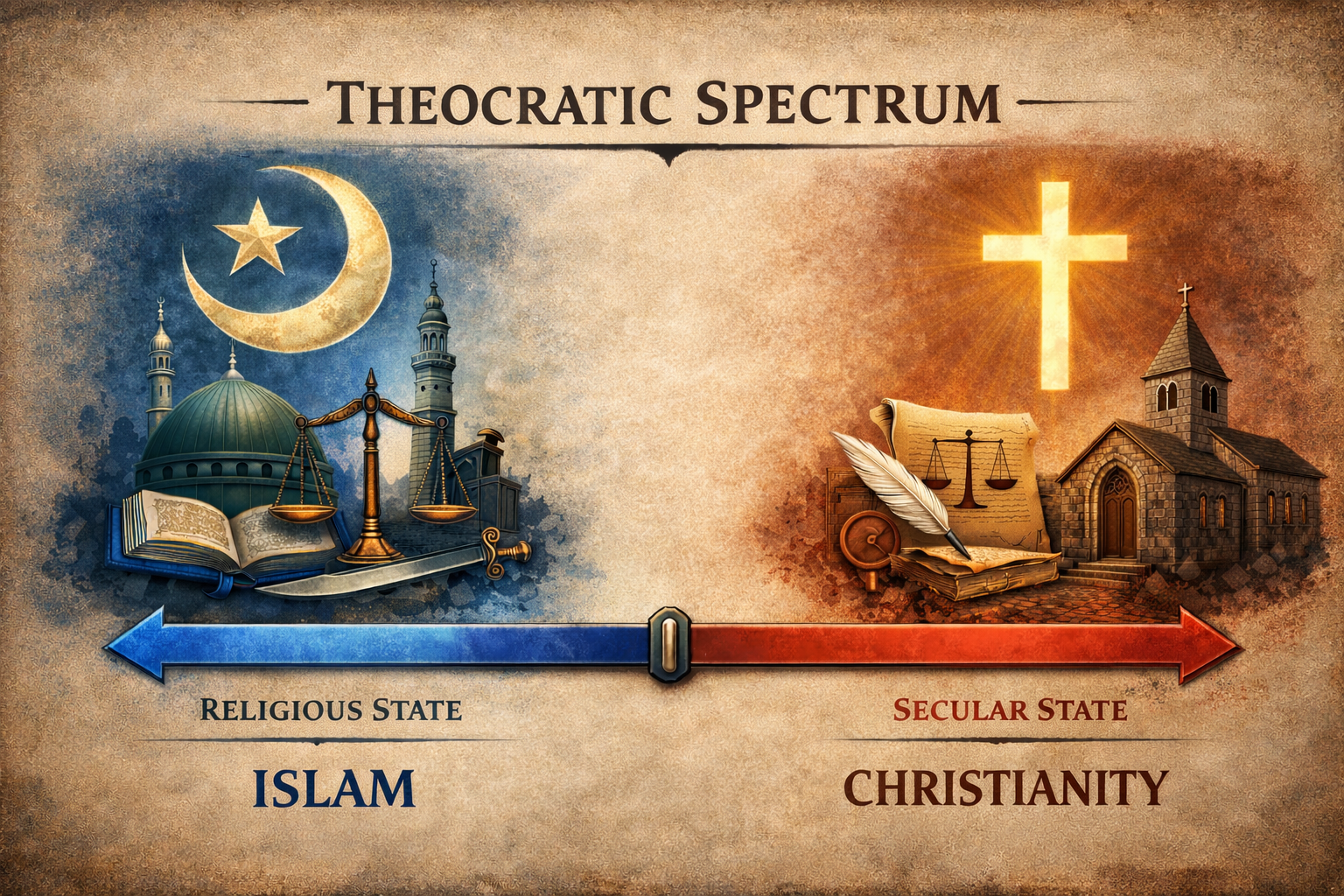
This is why the two systems anchor opposite ends of the theocracy spectrum.
Christianity says the state is necessary but not holy.
Islam says the state is holy because it is necessary.
Between these poles sit most of the world’s major religious traditions.
Judaism, for example, recognizes civil law as binding in practice while insisting that divine law remains supreme in principle. The law of the land governs daily life; God’s law governs ultimate obligation. This produces accommodation rather than separation—a workable coexistence, not a philosophical wall.
Hindu traditions divide existence itself into layers. Kings rule the material realm; sages pursue liberation from it. Politics is real, but transient. Sacred order underlies both domains, yet neither fully absorbs the other. Authority is hierarchical, not fused.
Buddhism steps sideways entirely. Enlightenment is an inward project; government belongs to the realm of impermanence and suffering. Rulers may support monasteries, but they do not derive authority from doctrine. This is separation by detachment, not by design.
Confucianism binds morality to governance without invoking revelation. Rulers must be virtuous, but they are not divine. Heaven grants legitimacy conditionally, not absolutely. Politics is ethical, not sacred.
These traditions populate the middle of the spectrum. They restrain power culturally, morally, or philosophically—but they do not split authority at the root.
Christianity and Islam are different because they answer the foundational question decisively—and in opposite directions.
Christianity fractures authority.
Islam consolidates it.
The middle positions moderate. The poles define.
None of this means Christian societies always lived up to their creed. They did not. History is littered with bishops wearing crowns and kings waving crosses. But Christianity’s internal logic made those abuses intelligible as abuses. Tyrants had to lie. They had to pretend. They could not simply say, “I am God’s law.” The sentence render unto Caesar sat there like a splinter beneath the skin of every would-be theocrat.
That splinter still matters.
In an age when politics once again demands total allegiance—when ideologies ask to be worshipped and governments ask to be loved—the old distinction looks newly subversive. The state wants everything. Christianity insists it cannot have everything.
Caesar may have the coin.
He may not have the soul.
That is not moderation.
That is revolution, held in reserve.