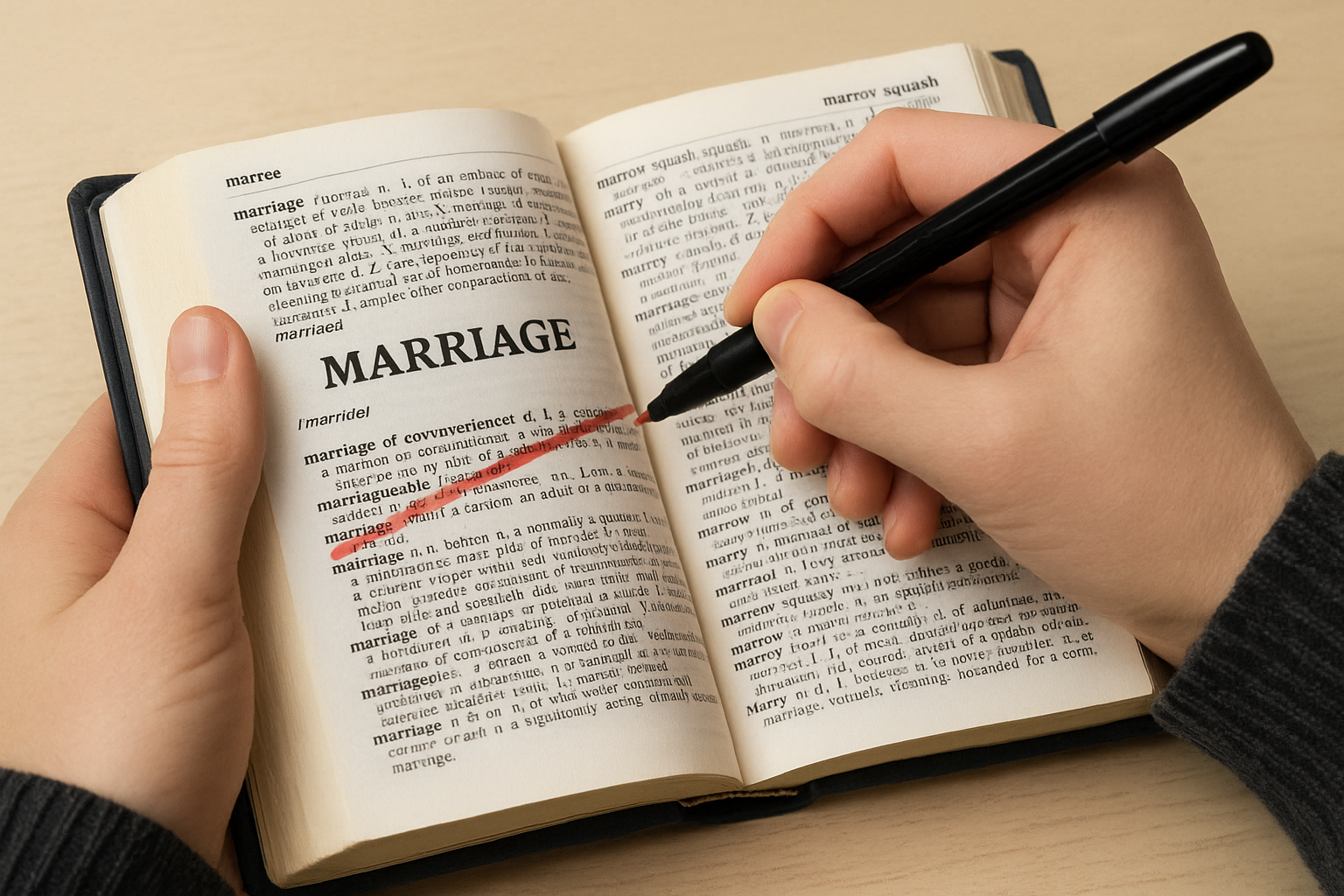
There are weapons of war you can see — bombs, bullets, tanks — and there are weapons designed to work in silence, slipping under the guard of a culture until the foundation cracks. Language is one of the most potent of these. And in our lifetime, some of the oldest words in our civilization — marriage, husband, and wife — have been stolen, emptied of their meaning, and refilled with something entirely different. This is not a harmless linguistic drift. It is an act of cultural sabotage.
The Roots of the Words They’ve Taken
The word marriage comes to us from Middle English mariage, borrowed from Old French, which in turn stems from the Latin maritare — meaning “to wed” or “to give in marriage.” For centuries, the term was anchored to the union of man and woman, not as a legal convenience, but as the bedrock of family and social order. Husband descends from Old Norse húsbóndi — literally “householder,” the man charged with stewardship of a home, provision for a family, and defense of both. Wife finds its root in Old English wīf, signifying a woman joined to a man in lawful wedlock, sharing in the covenant that shaped households, clans, and nations.
These words were not interchangeable placeholders. They carried centuries of law, religion, and custom inside them. To change their definition is not the same as coining a new phrase. It is to counterfeit the currency of the culture.
The Assault Was No Accident
This dismantling was not the slow erosion of time — it was a targeted strike.
In the 1960s and ’70s, second-wave feminism began stripping away the legal distinctions between husband and wife, framing them as relics of oppression rather than complementary roles. In the decades that followed, LGBTQ activism made “marriage equality” its flagship cause — not to create a parallel institution, but to redefine the original. Court battles like Goodridge v. Department of Public Health and Obergefell v. Hodges did not simply expand rights; they rewrote the definition of marriage in law, erasing the man–woman foundation entirely.
The Assault Was No Accident
This dismantling was not the slow erosion of time — it was a targeted strike.
In the 1960s and ’70s, second-wave feminism began stripping away the legal distinctions between husband and wife, framing them as relics of oppression rather than complementary roles. In the decades that followed, LGBTQ activism made “marriage equality” its flagship cause — not to create a parallel institution, but to redefine the original. Court battles like Goodridge v. Department of Public Health and Obergefell v. Hodges did not simply expand rights; they rewrote the definition of marriage in law, erasing the man–woman foundation entirely.
Language as the Prize
Here’s the key: they could have had the benefits without the word. “Civil union” could have carried all the same legal privileges. But they refused it. Why? Because language itself is power. Whoever controls the word marriage controls the legitimacy of the institution in the public mind. If marriage can mean anything, then marriage means nothing — and that was the point.
By keeping the same words but altering their meanings, they forced every participant in the institution — from the devout pastor to the lifelong traditional couple — to live inside the new definition. It’s not “inclusive” to take a word with centuries of specific meaning and hollow it out; it’s coercion dressed in legal robes.
The Step-by-Step Demolition
First, permanence was removed through no-fault divorce laws in the 1970s, turning a binding covenant into a dissolvable contract.
Next, gender roles were erased in law, dismantling the complementary structure of husband and wife.
Finally, the gender-pair requirement itself was discarded, completing the redefinition.
The civil definition of marriage today bears no resemblance to the historical one. It is now simply a state-sanctioned partnership between any two adults — genderless, transient, and stripped of its original cultural framework.
The Deliberate Choice
If this were merely about fairness, the state could have preserved the original definitions while creating an equal, parallel framework for others. The fact that they didn’t — the fact that they insisted on changing the original words — tells you the truth. This was not the accidental byproduct of progress. It was the intended outcome of a decades-long cultural and legal campaign.
Words carry the memory of a people. Change the words, and you can rewrite the memory. And once you have done that, you can erase the culture that gave birth to them.
What has been dismantled is not just a legal category, but one of the oldest and most coherent institutions in human history. To strip marriage, husband, and wife of their meaning is to cut the cord between the past and the future — to ensure that the next generation is born into a world where those words are little more than empty shells.
That is not progress. That is conquest.
Sources:
Oxford English Dictionary
Harper, Douglas. Online Etymology Dictionary
Goodridge v. Dept. of Public Health, 798 N.E.2d 941 (Mass. 2003)
Obergefell v. Hodges, 576 U.S. 644 (2015)
Cherlin, Andrew J. Marriage, Divorce, Remarriage (Harvard University Press, 1992)
Friedan, Betty. The Feminine Mystique (1963)
Maynard, Steven T. “Language and Cultural Change,” Journal of Social History, Vol. 37, No. 2 (2004)