There was a time when literature celebrated truth, even when it was brutal. When publishing sought excellence, even when it was inconvenient. But that time is slipping away, replaced by a bizarre ideological regime that punishes authenticity and rewards deception — provided that deception bows to the altar of “diversity.”
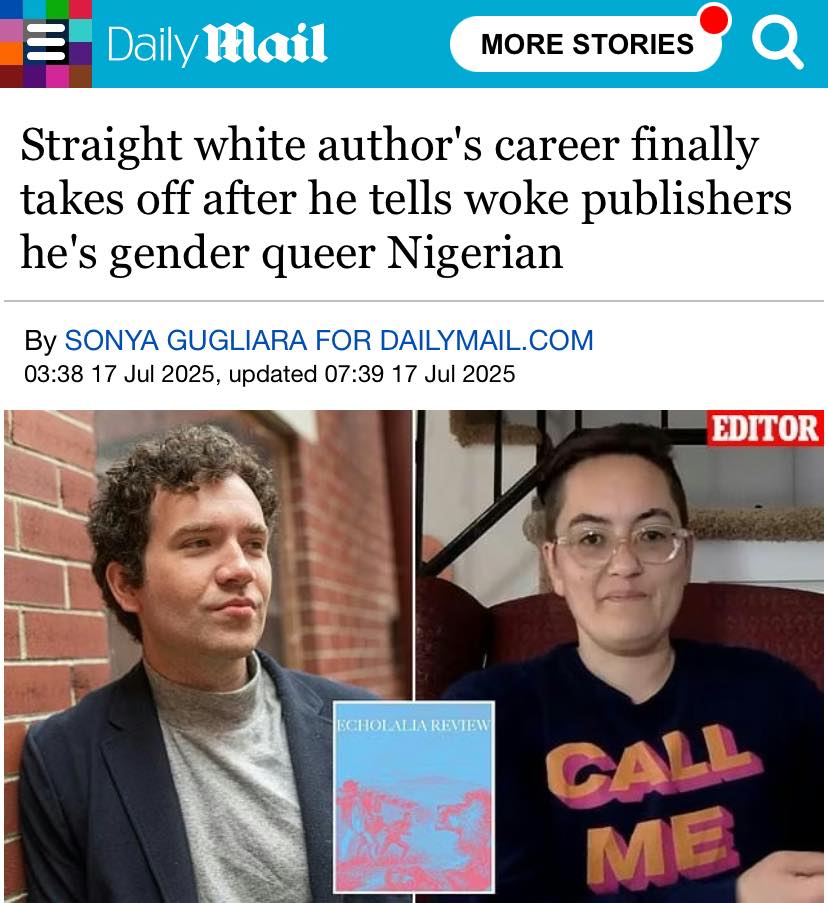
Consider the recent case of Aaron Bushkowsky, a white male poet from Vancouver who pretended to be a queer, Métis, two-spirit individual named “Aaron Barry.” Under this fabricated identity, he submitted a poem to a local literary magazine — and it was accepted. Not for its literary merit, mind you, but because it checked all the right identity boxes. When the truth came out, Bushkowsky was publicly condemned, not for poor writing, but for daring to mock the twisted gatekeeping that now rules publishing.
This is not satire. It’s a spotlight on a very real disease spreading through the cultural bloodstream: neo-racism, the belief that race, gender, and identity should matter more than merit, more than content, more than truth.
What Is Neo-Racism?
Neo-racism is the polished cousin of old-school bigotry, rebranded for elite acceptance. It doesn’t wear a hood or shout slurs. Instead, it smiles with corporate approval and university tenure. It divides people by skin color, assigns guilt or virtue by ancestry, and insists that some voices — often white, straight, and male — are inherently less worthy.
Publishing has been one of the worst casualties of this mindset. Just ask YA author Amélie Wen Zhao, whose debut novel was pulled before release in 2019 after accusations that it wasn’t sensitive enough to “oppression narratives.” Zhao, an immigrant from China, was told she didn’t suffer correctly.
Or look at Jeanine Cummins, author of American Dirt, who was pilloried not for getting facts wrong, but for not being “Latina enough” to write about the border crisis. The book was praised by critics — even Oprah — but the woke mob demanded racial authenticity, as if storytelling belongs only to tribes.
Marxism in a New Jacket
This is classic Marxism dressed up in cultural drag. Instead of bourgeois vs. proletariat, today’s divide is “oppressor vs. oppressed,” determined not by wealth or actions, but by immutable traits — skin, gender, sexual identity. It’s identitarian Marxism, and it doesn’t want fairness. It wants revenge.
Aaron Bushkowsky didn’t commit a crime — he exposed one. He proved what many of us already knew: that talent is now secondary to identity. That publishing has become a performance of virtue signaling, not a pursuit of truth. And that the gatekeepers of our culture no longer serve the reader — they serve the mob.
When Truth Becomes Taboo
Let’s be clear: Bushkowsky should not have had to fake an identity to test the system. But the fact that he had to proves how sick the system has become. The poem he submitted was no different from others he’d written — but once he claimed to be an oppressed minority, the doors opened. This wasn’t about the poem. It was about the politics of the poet.
The irony? Had he submitted under his real name, he likely would have been rejected for being white and male. That’s not equity — that’s discrimination with a new label.
This Isn’t Just Publishing
This same poison is in academia, where merit-based admissions are being dismantled. It’s in medicine, where health policies are weighed against racial equity rather than patient outcome. It’s in law enforcement, military recruitment, and even corporate hiring, where “representation” trumps qualifications.
We are building a society where success is no longer earned but assigned. Where truth is dangerous, and lies — if they’re woke enough — are rewarded.
What Would a Founder Say?
Jefferson believed in the power of reason and open inquiry. Lincoln fought for a nation where all were judged not by bloodline but by moral character. Today, the publishing industry dishonors both by treating literature not as an art but as a racial census.
We cannot build a just society on a foundation of neo-racism. We cannot defend liberty while fearing truth. And we sure as hell cannot preserve our culture by replacing talent with tokens.
The road back begins with courage — the courage to speak plainly, write boldly, and refuse to bow to the cult of identity.
Bushkowsky may have donned a mask, but he tore off a bigger one.
Sources:
- Daily Mail: “Poet Fakes Woke Identity” – July 2025
- NYT: “American Dirt and the Fault Lines of Appropriation” – Jan 2020
- NPR: “Why Jeanine Cummins’ Book Caused a Firestorm”
- The Guardian: “YA Author Cancels Book Over Cultural Concerns” – Feb 2019
- Thomas Sowell, The Quest for Cosmic Justice (2001)